

On September 15, 2025, the National Bureau of Statistics released macroeconomic data for August. Amid the dual challenges from both domestic and external factors, the August data continued the downward trend observed in the previous month. We have made the following observations: First, trade frictions have persistently suppressed private sector credit demand and hindered the recovery of China's real estate market. Second, "anti-involution" policies are still affecting manufacturing investment and output, though there has been some marginal improvement in August. Third, the decline in direct fiscal support for domestic demand has become more evident, with a noticeable impact on the economy.
In light of these developments, we believe that new incremental policies should be considered, including around one trillion yuan in (quasi-)fiscal measures. These could encompass the issuance of additional special treasury bonds and the deployment of policy financial instruments; along with substantial interest rate cuts, increase the intensity and scope of structural monetary policy tools; reduce the social security contribution burden on the private sector; and address the accounts receivable issues between government and enterprises.
On September 15, 2025, the National Bureau of Statistics released macroeconomic data for August. Amid the dual challenges from both domestic and external factors, the August data continued the downward trend observed in the previous month. However, some indicators showed marginal improvement, demonstrating that China's economy maintains considerable resilience.
Specifically, China's industrial value-added growth continued to decelerate, with industrial value-added by enterprises above designated size increasing 5.2% year-on-year in August, down 0.5 percentage points from July. Consumption growth continued to decline, with total retail sales of consumer goods rising 3.4% year-on-year, down 0.3 percentage points from July. CPI year-on-year growth remained at low levels, falling 0.4% year-on-year while remaining flat month-on-month. Fixed asset investment growth continued to decline, with cumulative fixed asset investment nationwide increasing 0.5% year-on-year in January-August, down 1.1 percentage points from January-July. Among the components, infrastructure investment grew 2% year-on-year, manufacturing investment increased 5.1%, and real estate development investment fell 12.9%, representing declines of 1.2, 1.1, and 0.9 percentage points respectively compared to the cumulative year-on-year growth rates in January-July. Export growth also declined compared to July, with exports denominated in US dollars growing 4.4% year-on-year in August, down 2.8 percentage points from July.
Based on the latest macroeconomic data presented above, we have the following observations regarding the changes and trends in China's macroeconomy in August:
First, trade frictions have exerted sustained restraining effects on private sector credit demand and the recovery of China's real estate market. Since April, escalating global trade frictions have begun to suppress private sector credit demand and the recovery of China's real estate market.
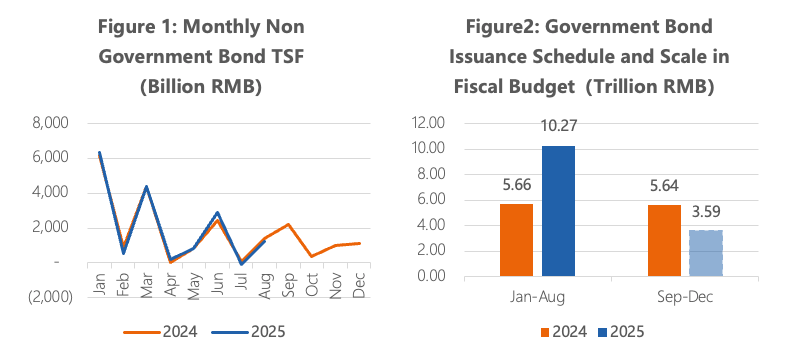
On the credit side, the cumulative increase in total social financing (TSF) reached 26.56 trillion yuan in the first eight months of 2025, marking a y-o-y increase of 4.66 trillion yuan. However, 4.63 trillion yuan of this increase was driven by additional government bond issuances, suggesting that both the household and corporate sectors did not experience significant net credit growth. This is partly due to some government bonds replacing previous loans. Excluding the temporary recovery in June, the monthly increase in TSF for the private sector has shown a contracting trend since thef trade frictions in April. Meanwhile, government bond issuance in China totaled 10.27 trillion yuan from January to August this year, a substantial rise from 5.66 trillion yuan year-on-year. This indicates that the remaining government bond issuance quota for September to December is limited to 3.59 trillion yuan, resulting in a shortfall of around 2 trillion yuan compared to the same period last year. This shortfall is likely to constrain TSF growth in the upcoming months.
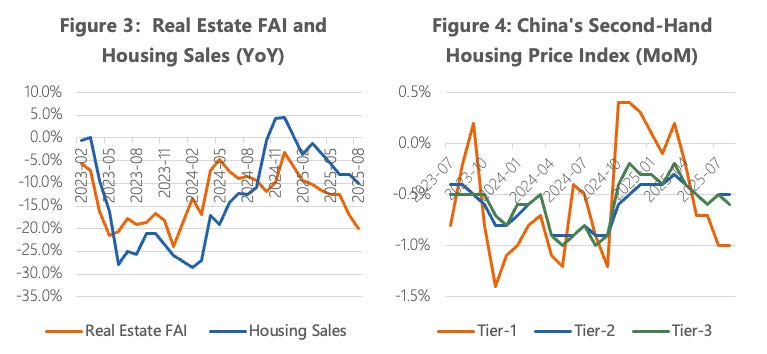
The further adjustment in the real estate sector also reflects the pronounced wait-and-see sentiment in the private sector. In August 2025, China's real estate development investment completed amount declined by 19.9% year-on-year, while commercial residential sales area fell by 10% year-on-year. Both indicators have shown accelerating month-on-month declines since April, creating a sustained divergence from the stable or rising growth rates observed before April. Meanwhile, China's second-hand residential price index has also exhibited a downward trend since April.
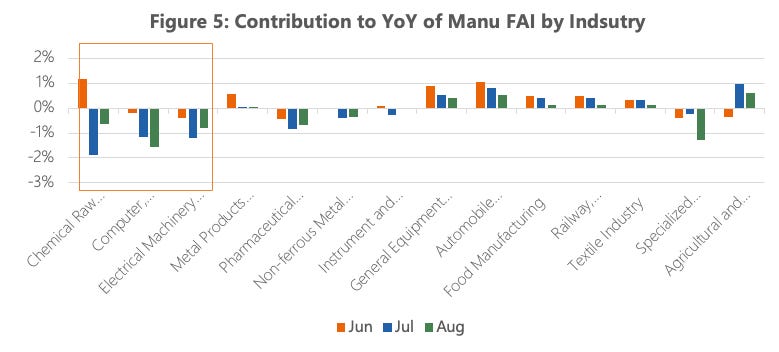
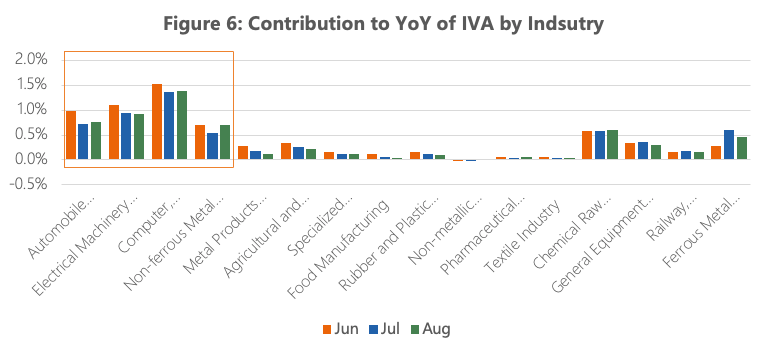
Second, "anti-involution" policies continue to exert sustained impact on manufacturing investment and output, though some marginal improvement emerged in August. In August 2025, the year-over-year growth rate of fixed asset investment in manufacturing was -1.3%, declining by 1 and 6.3 percentage points respectively compared to July's -0.3% and June's 5.1%. The year-over-year growth rate of value-added by above-scale industrial enterprises in manufacturing was 5.7%, declining by 0.5 and 1.7 percentage points respectively compared to July's 6.2% and June's 7.4%.
From an industry contribution perspective, the three sectors most closely associated with "anti-involution" policies—chemical raw materials, computers, and electrical machinery—collectively contributed -3% to manufacturing fixed asset investment growth in August, an improvement from the -4.2% contribution in July, but still 2 percentage points lower than the -1.0% recorded in June. Additionally, the combined contribution of automotive, electrical machinery, computers, and non-ferrous metals to industrial value-added growth was 3.0% in August, unchanged from July but 1.3 percentage points lower than the 4.3% in June. Changes in these industries explain most of the decline in manufacturing fixed asset investment and industrial value-added. This indicates that under the influence of "anti-involution" policies, China's manufacturing investment and output continue to face pressure. However, compared to July, the August data showed some marginal improvement.
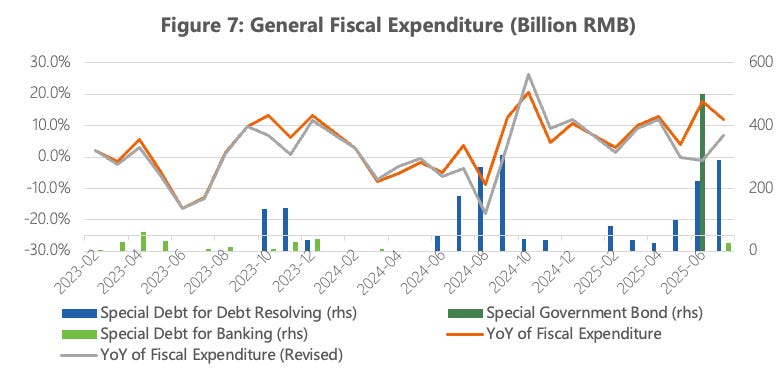
Third, the marginal decline in direct fiscal support for domestic demand has become more apparent in its economic impact. In July, broad fiscal expenditure (general public budget expenditure plus government fund expenditure) grew 12.1% year-on-year, maintaining a relatively high level. However, after excluding special government bonds for capital injection, special-purpose bonds, and special bonds supporting capital replenishment for small and medium-sized banks from government fund expenditure, the adjusted broad fiscal expenditure growth rate was only 6.9% year-on-year. On this basis, given the multiple factors affecting key provinces' debt resolution from early 2024 through August, the base for adjusted broad fiscal expenditure in July of last year was not high. From an absolute volume perspective, there remains room for further improvement in the level of adjusted broad fiscal expenditure.
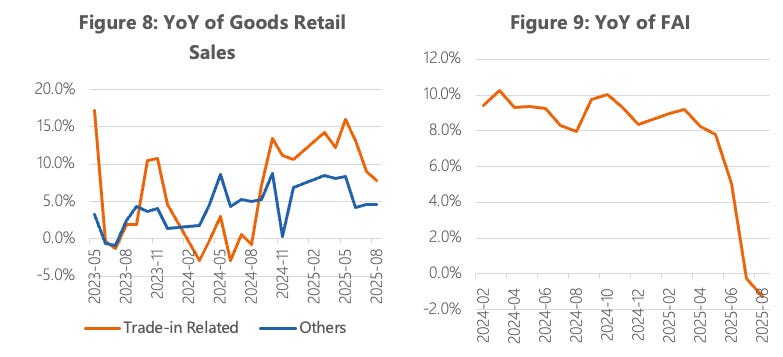
The weakening of fiscal spending on domestic demand has resulted in further deterioration of consumption and investment. On the consumption front, retail sales of consumer goods grew 3.4% year-on-year in August, with retail sales of goods related to trade-in programs increasing 7.8% year-on-year, down 1.2 percentage points from July and 8.3 percentage points from the May peak. Meanwhile, retail sales of other goods remained relatively stable, growing 4.6% year-on-year in August, unchanged from July. On the investment front, China's monthly year-on-year growth in completed fixed asset investment has accelerated its decline since April, posting negative growth for two consecutive months through August. Without additional policy support, China's fixed asset investment may continue to remain subdued for the rest of the year.
These data and facts indicate that the necessity and urgency of introducing a new round of policy measures in the fourth quarter have further increased. We believe the new round of incremental policies should focus on four aspects:
First, consideration should be given to adding approximately one trillion yuan in (quasi-)fiscal measures, including the issuance of additional special government bonds and the deployment of policy financial instruments. This year's government fund expenditures include three types of spending with limited effects on domestic demand stimulation: capital injection special government bonds, special-purpose bonds for debt resolution, and special bonds supporting small and medium-sized banks. Therefore, to ensure that fiscal policy continues to play its expenditure role in supporting aggregate demand, it is necessary to issue additional special government bonds or deploy policy financial instruments in a timely manner, with a scale of approximately one trillion yuan.
Second, while implementing substantial interest rate cuts, increase the intensity and scope of structural monetary policy tools. The reduction in real interest rates helps stimulate credit demand and restore economic vitality. Meanwhile, structural monetary policy tools should be fully utilized to achieve the macroeconomic effect of directly boosting credit expansion.
Third, reduce private sector social security contribution levels, lower the social security burden on residents and enterprises, and increasingly utilize new special government bond issuances and state-owned asset transfers to supplement the social security system. For low-income earners, social security contributions represent a significantly larger proportion of their work income compared to high-income groups. Therefore, reducing the private sector's social security burden will be more conducive to boosting employment and raising the disposable income levels of low-income groups.
Fourth, moderately relax the restrictions on special bond usage and consider providing additional policy tools to address accounts receivable issues between government and enterprises, thereby providing certain support for alleviating corporate cash flow pressures.